Encrypting your link and protect the link from viruses, malware, thief, etc! Made your link safe to visit.


Question
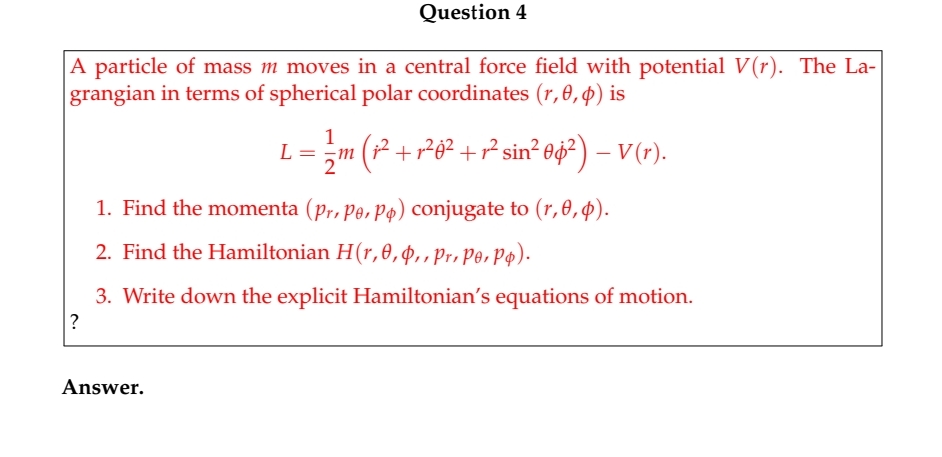
A particle of mass m moves in a central force field with potential V(r). The La- grangian in terms of spherical polar coordinates (r, 0, 4) is m (2 +rô² +r² sin² 04? ) – V(r). 1. Find the momenta (p, Po, Po) conjugate to (r,0,p). 2. Find the Hamiltonian H(r,0,4,,Pr, Pe, Pg). 3. Write down the explicit Hamiltonian's equations of motion. ?

Image Transcription

A particle of mass m moves in a central force field with potential V(r). The La- grangian in terms of spherical polar coordinates (r, 0, 4) is m (2 +rô² +r² sin² 04? ) – V(r). 1. Find the momenta (p, Po, Po) conjugate to (r,0,p). 2. Find the Hamiltonian H(r,0,4,,Pr, Pe, Pg). 3. Write down the explicit Hamiltonian's equations of motion. ?

Answer
Step 1


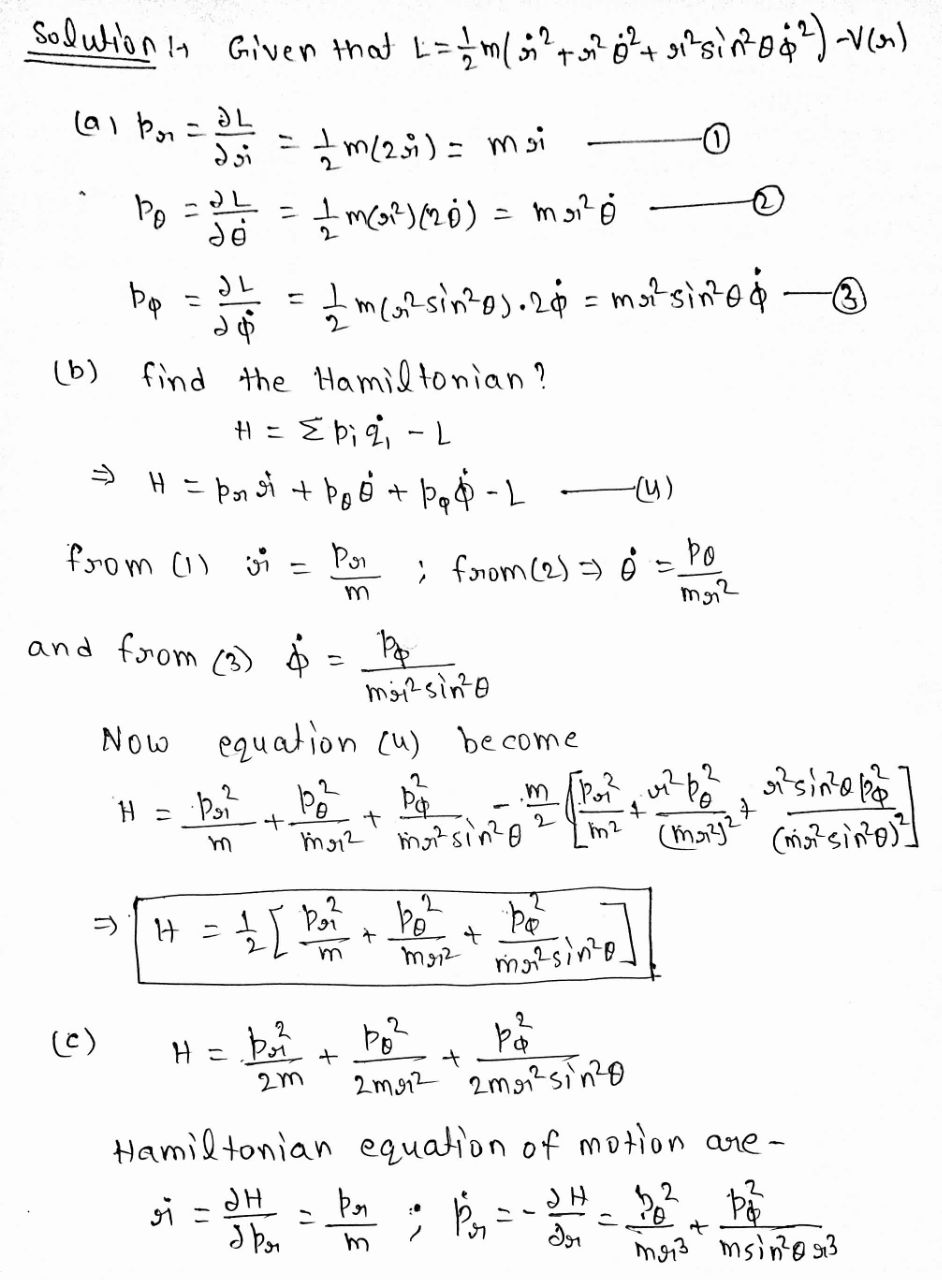
Step 2

Physics homework question answer, step 2, image 1

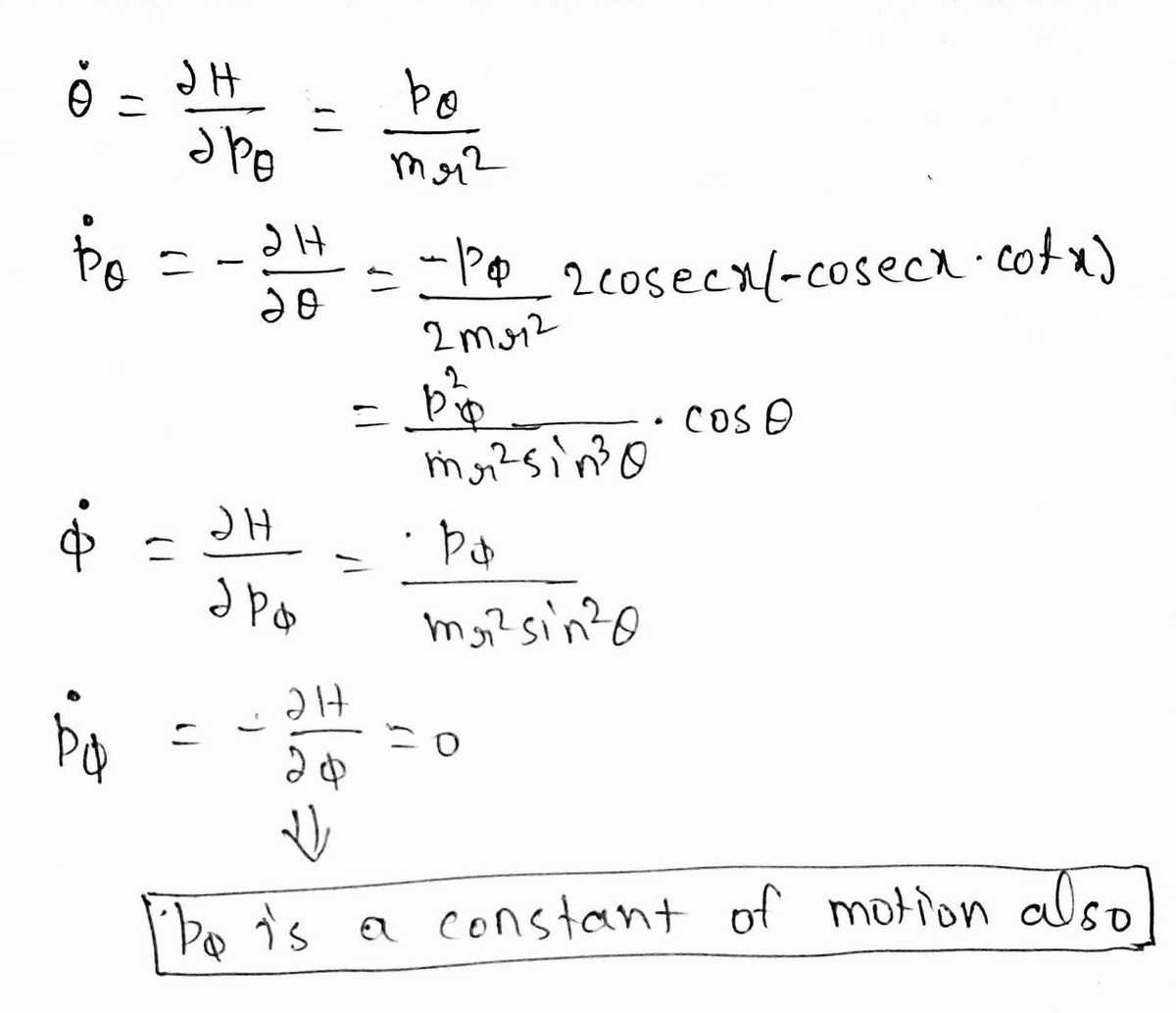
Step 3

Physics homework question answer, step 3, image 1


ST

Search This Blog

Labels

Report Abuse

A palindrome is a number or a text phrase that reads the same backwards as forwards. For example, each of the following five-digit integers is a palindrome: 12321, 55555, 45554 and 11611. Write a C++ program that reads in a five-digit integer and determines whether it is a palindrome .

Question: A palindrome is a number or a text phrase that reads the same backwards as forwards. For example, each of the following five-digit integers is a palindrome: 12321, 55555, 45554 and 11611. Write a C++ program that reads in a five-digit integer and determines whether it is a palindrome . Answer: Step 1 PROGRAMING CODE:   #include <stdio.h> int main() {   int n, a, b, c, d, e;   int digit = 0;   printf( "Enter one 5 digit number: \n" );   scanf( "%d", &n );   a = n / 10000;   b = n / 1000 % 10;   c = n / 100 % 10;   d = n / 10 % 10;   e = n % 10;   if ( a == e && b == d ) {     printf( "Palindrome!\n" );   }   if ( a != e || b != d ) {     printf( "Not a palindrome.. :(\n" );   }   return 0; } PROGRAM SCREENSHOT: Step 2

QUESTION 6 (a) The bar shown in Figure Q2(a) is subjected to tensile load of 150 Kn. If the stress in the middle portions is limited to 160 N/mm², determine the diameter of the middle portion. Find also the length of the middle portion if the total elongation of the bar is to be 0.25 mm. E E = 2.0 + 105N/mm². (12 marks) 150 KN 10 cm DIA 10 cm DIA 150 KN 45 cm Figure Q6(a) (b) A brass bar, having cross-section area of 900 mm², is subjected to axial forces as shown in Figure Q2(b), in which AB = 0.6 m, BC = 0.8 m, and CD = 1.0 m. Find the total elongation of the bar. E = 1.0 + 105N/mm2 . (8 marks) Page 4 of 5 B D 40 KN 70 KN 20 KN 10 KN Figure Q6(b) (TOTAL = 20 MARKS)

  Question: Show transcribed image text Answer:

Contributors